Valentines?

I just thought I would take a moment to discuss the middle of the month, and possibly the day February is most famous for Valentines Day. Now I am sure you have heard many variations of why Valentines day is named as it is and despite origins it is now the day widely synonymous with romantic love.

If you have someone to send a valentine card to, take out to a meal or express your deep affection for I wish you the best day. If you are one of the many who find this holiday difficult or challenging maybe a few of these ideas may help.

Firstly if you struggle to express emotion or understand your partners way of expressing emotion have you explored your love language? Here is a brief article on the 5 types of love language : verbal, quality time, physical touch, acts of service, gifts.

Not all love has to be big, expensive gestures, a beautiful pebble or handmade card can mean just as much. Cleaning the house, making dinner, carpet picnics, going to a walk together can al be just as rewarding as diamonds, chocolates and dinner.

If you are single consider expressing or celebrating another type of love to a person in your life, tell your best friend how much you love them, let your parents or children know how much they mean to you, offer love to a stranger by volunteering or handing out chocolates at work (remember these are just my spur of the moment ideas, you may wish to add your own spin).

And more still, remember love is expressive 365 days a year, not just today, sending your love on November 12th is just as important as it is on February 14th.

If you’d like video, telephone or face to face counselling in the Stoke-on-Trent, Newcastle-under-Lyme or Staffordshire area please do contact Wright Minds at laura@wrightminds.co.uk or on 07598810304

The Emotion Wheel

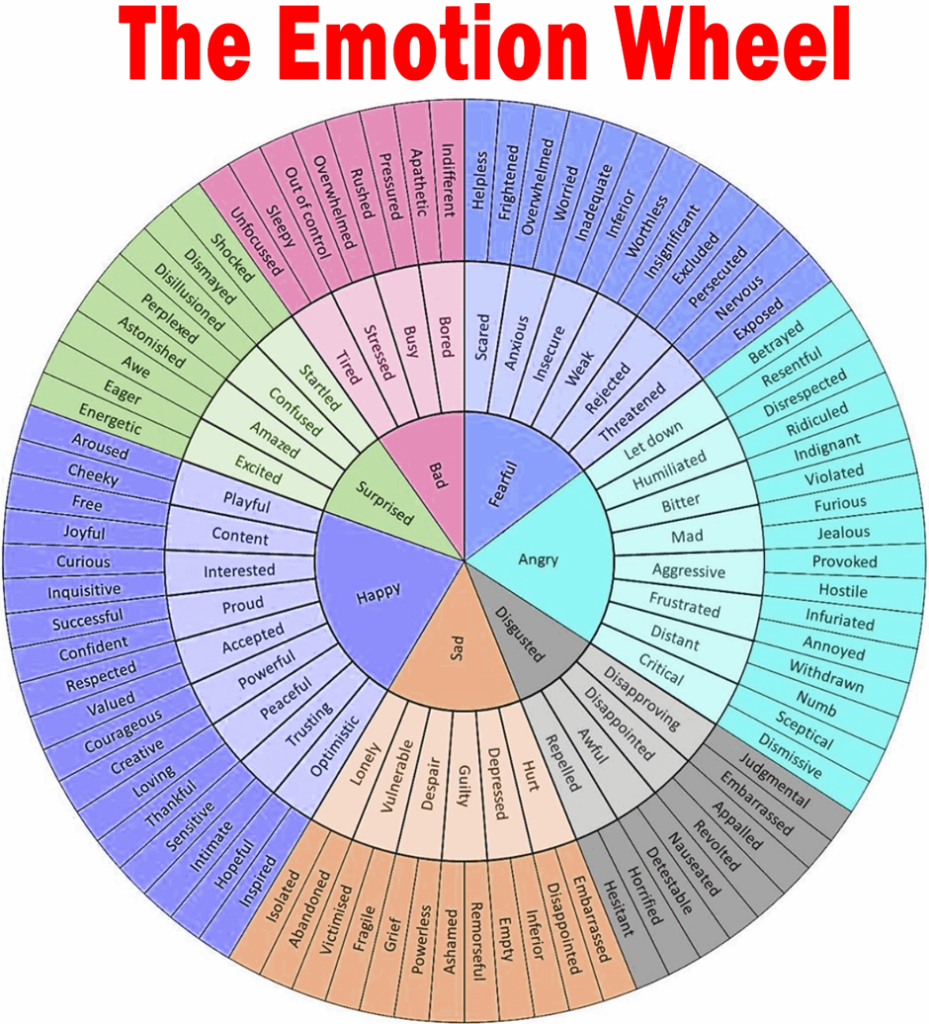
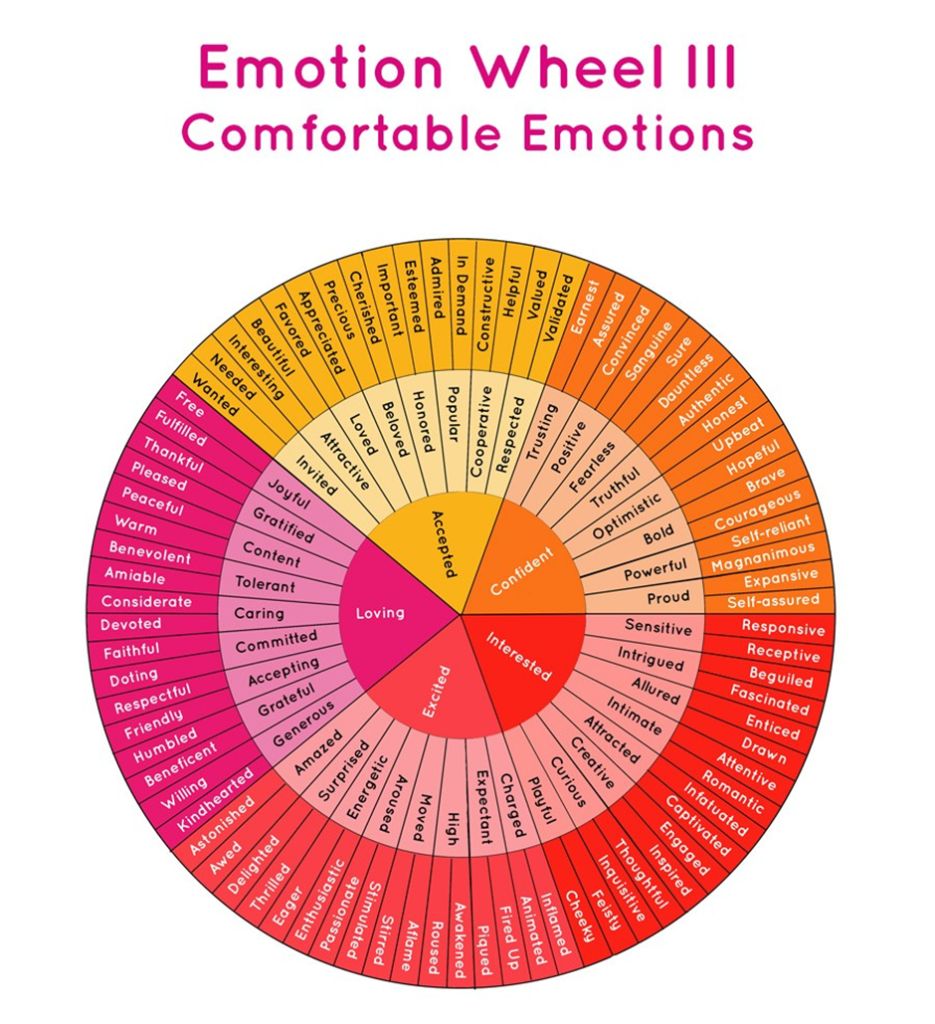
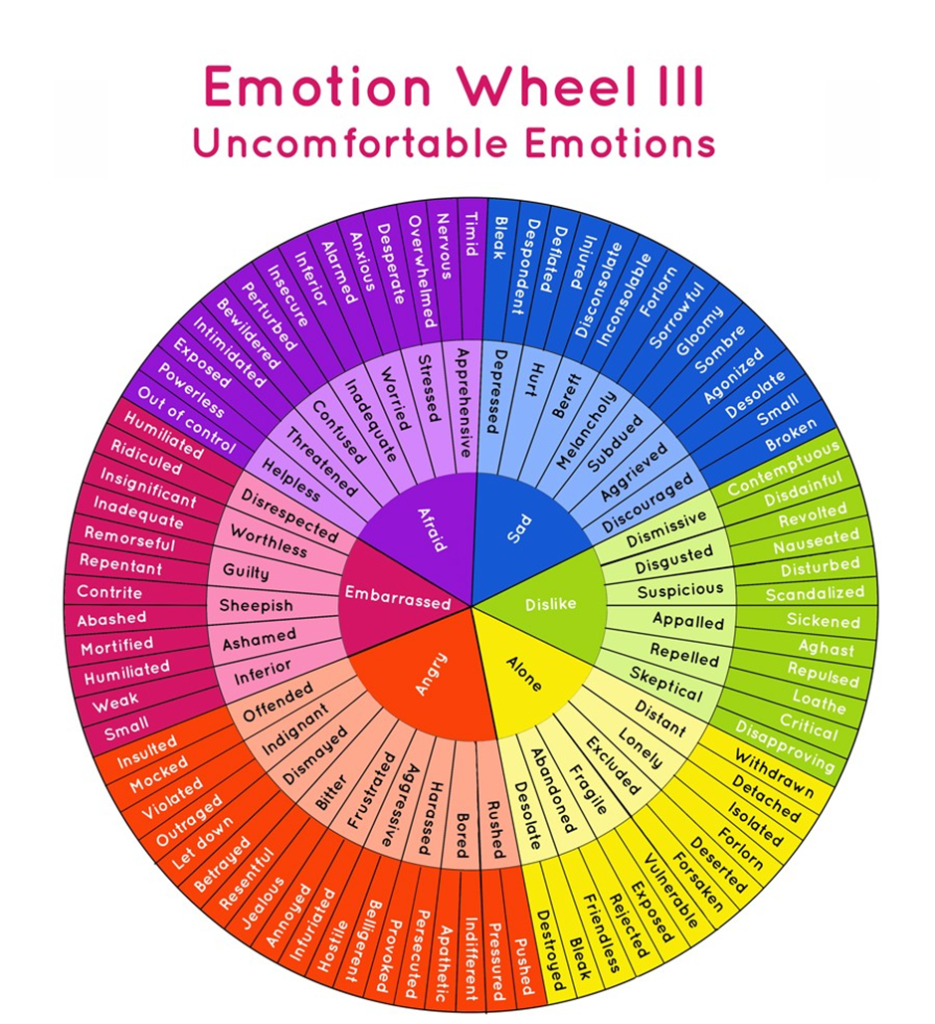
The Emotion Wheel, sometimes called The Feelings Wheel is a technique used to help people be better able to express the complex emotions they may be feeling. The images in the blog are taken from https://humansystems.co/emotionwheels/

The idea is a very simple one, if people are struggling to describe or understand their own emotions often a therapist will use a wheel to help the client explore their emotion in more detail. For example if a client says they feel angry because someone made a joke that used them as the punchline. You could use the word wheel, and your own understanding of emotions to maybe follow that emotion to level 2 and find the word humiliated, that may then be level 3 disrespected. The idea is to help more fully understand their reaction and thus explore the client’s response and way they process the emotion.

Here are 3 examples, the main emotion wheel, then two more specific ones for comfortable and uncomfortable emotions, because knowing a feeling doesn’t just have to be focused on a negative emotion, and finding more positive ways to feel is also part of therapy.

I hope these help, feel free to make use of them yourselves.

https://humansystems.co/emotionwheels/

If you’d like video, telephone or face to face counselling in the Stoke-on-Trent, Newcastle-under-Lyme or Staffordshire area please do contact Wright Minds at laura@wrightminds.co.uk or on 07598810304
Crisis?

Just a brief one from me for December which is to remind you that every day is what you make of it and what you want it to be. If you celebrate Yule, Christmas, Diwali, Hanukah, or the New Year then I wish you a most enjoyable festival of light in the winter darkness and the turning of a new year. Equally if you do not wish to celebrate, or if this time of year is tough for you remember that is up to you how you choose to feel and approach the time of year. If you wish to do charity work to keep busy, spend time not money with loved ones, go travelling or just act like it is a normal day then I am here to say that is the best and right decision for you and no one should be able to take that from you. It’s not selfish, its self-care, just remember to be sure your choice isn’t damaging or dangerous for another.

Also if you are struggling as this time of year is tough here are a few key numbers that may help you out:

If you are struggling at this time of year and if I am closed or it is the holidays here are some numbers and websites that may help:

Samaritans – 116123   https://www.samaritans.org/

Accesss Team – 03001230907

Childline – 0800 1111 childline.org.uk

Staffordshire Mental Health Helpline –  0808 800 2234 

Staffordshire rough sleepers team – 0300 500 0914

Stoke-on-Trent rough sleepers – 01782 406000, 0800 970 2304

Food Bank information – Staffordshire: https://www.staffordbc.gov.uk/local-food-banks-information-and-opening-times  Stoke-on-Trent: https://stokeontrent.foodbank.org.uk/

Loneliness – https://www.u3a.org.uk/

And remember if in doubt call 999 for immediate support

Grief

I wanted to use this month’s blog to chat about grief. It is the festive time of year soon and many of us will be spending this season without a loved one who was there last year. Sometimes people find this time very hard emotionally and having not experienced grief before may not know what to expect, feel or do for the best. Well I am here to let you know that it is totally normal and OK to not know how to ‘do’ grief correctly, there is no correct way to grieve or act, especially at those festive times when you may just have a reminder of the past wash over you. What you feel is right, allow the feelings, accept the feelings, work with them not against them and work through them. Allow them, feel them and find a way to step forward from them rather than stay in them. Just remember as long as everyone is safe and your grief is not damaging to you or others how you need to grieve is OK.

So although I can’t tell you how to grieve or what to do to make it easier I can offer a few ideas that might help:

  • Some pagan traditions encourage telling stories of the dead to friends and family, often around a festive fire (remember safety) – maybe nice for bonfire night.
  • Another pagan idea is to share your drink with loved ones by spilling some out onto the floor in their name (again probably best outside and not red wine on the white carpet)
  • Some people like to leave an empty seat/full place setting at the Christmas dinner table
  • Some people like to take a Christmas card to the grave or memorial stone of their loved one
  • Some like to plant a Christmas tree in their honour or make a charitable donation
  • Some like to buy a small low value gift to honour their dead.
  • An idea can be to collect stories, photos and memories about the deceased from all the family and create a memory book (or a memory stick in the digital age) to be shared among all contributors/friends/family and used as a talking point.

These are but a few small ideas to hopefully inspire you to realise that you can remember those not with us in a way that is right for you and your family.

If you’d like video, telephone or face to face counselling in the Stoke-on-Trent, Newcastle-under-Lyme or Staffordshire area please do contact Wright Minds at laura@wrightminds.co.uk or on 07598810304
5 Years as Wright Minds!

Well I thought it was worth a celebration blog. The 1st Oct marks 5 years of Wright Minds, from humble beginnings with only 1 client a week the business has grown to allow me to offer 20 counselling hours a week, with a reduced rate for those on low income, students, or retired. In that time I have undertaken over 2000 hours worth of counselling, I have been able to move offices to a larger office with nicer facilities for my clients, attended multiple professional development days, weathered the onslaught of COVID and I just want to thank you all for taking part in the journey so far, I hope one day I will be writing my 10th, 15th or 20th anniversary post and that you will be reading them.

In 5 years I have attained certificates as a Trauma therapist, an anxiety management diploma, a CBT diploma, a Mindfulness diploma, completed a depression focused therapy certificate, undertaken a course on ADHD and Autism within counselling, increased my awareness of obsessions in therapy, improved my understanding a LGBTQ therapy spaces, completed mandatory updates for adult and child safeguarding.

COVID was a challenge for many but I was able to increase my use of video counselling (for those wondering this was the topic of my dissertation 12 years ago) and ensure that clients still had access to safe and helpful support when they needed it, COVID changed many lives and now Wright Minds is working in the new post pandemic world with even more flexibility offering video, telephone or face to face therapy to suit the clients needs.

Thank you for your support and I’ll see you in next months blog post.

Trauma and Person Centred Counselling

The following is a short piece written about combining my theoretical counselling orientation with the additional skills and certifications I have learnt since I qualified over 12 years ago. It is about being an integrative therapist.

My theoretical underpinnings come from Person Centred (PC) theory but my skillset is more integrative than that original learning. PC does not necessarily have a direct link to treating trauma and is often overlooked as a preferred treatment method in cases of PTSD, Rogers was writing before PTSD was used as a diagnosis. However, I feel that his belief that being in open psychological contact and offering unconditional positive therapeutic regard can help the client accept themselves and the trauma they have experience, thus in a safe and nurturing environment they may feel safe enough to start to explore and desensitise themselves from their trauma.

PC offers a deep and valuing approach to others traumas and subjective experiences, it does not require a medical model of tick this box to prove you have trauma. PC allows for the client to self-actualise and come to full acceptance of themselves and their experiences. PC recognises that the trauma is an experience that in incongruent with the client self-structure, thus the self-structure breaks down and denial of awareness can occur. PC working at relational depth with the client (the therapist being willing to go where the client goes and be congruent) then allows for the client to become more congruent and aware of events in a safe environment hopefully allowing then to integrate their experience into a new self-structure that is accepting of the traumatic experience and reach the actualising tendency.  It allows the client to work at their comfortable pace and rather than fixing the problem lets them become the new person fully integrated and at peace with their experiences.

Additionally I have a medical/biological understanding of how the brain processes trauma in the frontal lobe and then stores it in the hippocampus, and that if during this normal chemical process of storage if the brain does not process the memory correctly/normally for some reason, eg imbalance of chemicals due to heighten fight/flight/freeze state then the memory can become lodged or stuck creating flashbacks, making the person feel they are living the event and respond thusly (panic attack, attacking, hiding or running away), or that they are constantly in a heightened state of awareness causing additional chemicals in the body such as adrenaline as the body thinks it is reacting to a traumatic event.

In trauma cases I allow the client to work at their speed, to recognise the trauma and how it has impacted on them as an individual, I allowed the client to feel that I trust and believe in them and the safe counselling environment, I let them explore their feelings without an over-reaction or judgement. Clients often recognised that they are stronger than they believed that they have survived, they become congruent and do self-actualise. In additional training of Mindfulness and CBT techniques I would add to this relational depth approach the idea that reliving the trauma can help the client to adjust their storage and processing of the offending experience, sometimes called exposure therapy in CBT, it helps the client to better process and store the memory when it is discussed and relieved in a safe an d nurturing environment. This can be done by talking therapy such as PC, or by writing therapy (writing out the event to normalise it, or event changing the ending to help find closure for the client), or by drama therapy, hot seating (acting out the trauma to normalise the experience or desensitise the client, for example they may realise it was not as awful as they remember or they realise they are still alive and survived it, maybe become accepting or proud), some clients like to make use of their experiences to help other to help them feel fully actualised and whole again, some clients just feel safe being in psychological contact with someone who is accepting of their experience. Some clients benefit from mindful techniques to help them sooth their panic attacks or control their raging thoughts so that they are better able to process the events that they have experienced.

My aim as a therapist working with trauma clients is to find a way to integrate various techniques I have learnt in a safe way into the basis of PC theory.

If you’d like video, telephone or face to face counselling in the Stoke-on-Trent, Newcastle-under-Lyme or Staffordshire area please do contact Wright Minds at laura@wrightminds.co.uk or on 07598810304

Imposter Syndrome

I have heard this term repeatedly recently both in my professional life and my personal life from friends. It has got me thinking what is imposter syndrome really, do we understand what it means, are we using the right term for our feelings and, do we all have moments of imposter syndrome at times?

I went looking for some information and I found a wonderful article on Welldoing that I want to share with you, it is brief and it points you in the direction of further reading if you wish to do more research your self.

In brief Imposter Syndrome is the feeling that you are achieving only due to luck or accident and that you do not deserve to be where you are, that at any moment someone will realise you don’t deserve what you have and take it from you leaving you feeling humiliated. For example, the promotion or job that you just got is only an accident, or that they read the wrong name and will ring you back to tell you it was all a mistake. This feeling of incompetence, self doubt and deserving failure persist regardless of how much you try to focus on your achievements, educational success or hard work. Most people are left feeling anxious and push themselves harder and harder becoming over achievers to compensate for what they believe to be a real lack of skill or knowledge.

It is commonly believed there are 5 types of imposter syndrome: The Expert, The Superhero, The Soloist, The Genius, and The Perfectionist.

In therapy we would look at the start of the imposter syndrome, the type of imposter syndrome and create an individualised plan to help change, adapt and alleviate those thoughts, feelings and behaviours. Another article from Healthline goes into further detail about ways you can start to overcome these feelings yourself.

If you’d like video, telephone or face to face counselling in the Stoke-on-Trent, Newcastle-under-Lyme or Staffordshire area please do contact Wright Minds at laura@wrightminds.co.uk or on 07598810304
Nervous system in response to trauma and soothing.

The brain has several areas one of which is the limbic system controlled by the brain stem, the cerebellum, the hippocampus, the amygdala, and the hypothalamus is the area of the brain controls the autonomic nervous system, this is one of our basic systems and can be colloquially referred to as our animal instinct or unconscious control. Its main job is to help with memory creation, storage and retrieval, it helps use feel emotions, and link intellectual conscious thoughts of the cerebral cortex with the unconscious, autonomic functions of the brain stem, it also controls the glands and muscles of internal organs, our basic breathing, digesting processes that we do not have to think about.

This is then divided into two subsystems – the sympathetic nervous system and the parasympathetic nervous system. The sympathetic nervous systems role is to arouse the body when needed, to put it on alter, to respond to threats, to survive. Meanwhile the parasympathetic nervous system has the opposite effect, its role is to calm the body when danger has past and it is time to relax. This creates our fight or flight (and don’t forget freeze) system. So when we are threatened our sympathetic nervous system, part of the limbic system floods the body with hormones which are message to tell the body to increase heart rate, breathing and blood pressure ready to fight or flee. This I guess is the bit you all know. However, the part often not talked about is once the threat is gone, the parasympathetic system then kicks in to return the body to a state of calm by trying to reverse the physical effects caused by the sympathetic nervous system release of hormones.

The parasympathetic nervous system can take roughly 20 minutes to 60 minutes to produce this calming process, it does so by releasing hormones (they carry messages to systems and organs) to slow our heart and breathing rates, lower blood pressure and promote digestion thus our body enters a state of relaxation, and in this relaxed state we can recover physically and mentally, we heal ourselves (hence rest when we have had surgery).

In terms of trauma, which is an event that has caused our limbic system to trigger fight or flight reactions as above, if this trauma becomes chronic, so multiple events or ongoing situations that our brain responds to with a trauma reaction, our bodies remain in a constant state of alertness, flooded with fight or flight hormones, in order to be ready for threats. This ongoing activation is extremely taxing and draining on the body and can frequently lead to many health problems, including a weaker immune system, frequent headaches, insomnia, depression and anxiety amongst other issues because the body is having no tie to relax, digest, heal, or sooth itself, the stress hormones are very exhausting to the body. Additional this constant state of alertness can reduce our ability to tell the difference between genuinely threatening events and harmless events that have similar trigger factors, thus our limbic system triggers for the wrong causes (for example an abuser wore a certain fragrance, so that fragrance becomes a trigger even if it is not worn by the abuser. Or soldiers overly reacting to loud bangs when not at war).

The key is to recognise this above reaction in yourself, and with therapy and certain techniques reduce the limbic systems reaction and stimulation of the sympathetic nervous system and to promote the response of the parasympathetic nervous system to help reduce fear hormones and to promote healing.

If you’d like video, telephone or face to face counselling in the Stoke-on-Trent, Newcastle-under-Lyme or Staffordshire area please do contact Wright Minds at laura@wrightminds.co.uk or on 07598810304

Window of Tolerance

This is an exercise I have learnt from my trauma training course. It is designed to help people recognise their triggers or intolerances that impact on their emotional responses and cause them to leave what we usual call our ‘comfort zone’, that area where we feel safe or happy with the emotion we are experiencing. For example you may feel comfortable with a little stress at work but at some point that little stress will grow and become an intolerance or trigger causing you to feel uncomfortable or to react such as crying or shouting. This window of tolerance and our ability to calm ourselves and stay within it can shrink if we are exposed to things we find traumatic and if we have no way of coping with the trauma.

So the window of tolerance has 3 main zones. These are the hyperarousal area, the window of tolerance and the hypoarousal area, btween these areas is almost a grey area or flexible zone called dysregulation, learning to recognise this can be a good way to prevent slipping completely into hyper or hypo arousal.

HYPERAROUSAL is when you feel strongly anxious, angry, or out of control; feelings of being threatened or frightened can overwhelm you, and you might want to fight or run away.

DYSREGULATION (hyper) is when you start to notice feeling agitated or uncomfortable. You don’t feel out of control yet but you can feel uncomfortable, anxious, revved up, or angry.

WINDOW OF TOLERANCE is where things feel just right, where you are best able to cope with the punches life throws at you. You’re calm but not tired. You’re alert but not anxious.

DYSREGULATION (hypo) is when you start to feel like you’re shutting down. You don’t feel out of control yet but you can feel uncomfortable spacey, sluggish, slow or even like you have lost track of time.

HYPOAROUSAL is when you feel strongly numb or unfocused (sometimes people say zoned out) emotionally and/or physically. Your body takes over and you can feel frozen or like you have lost time but don’t know what you have been doing.

Try the Window exercise for yourself. Under the three headings hyperarousal, window of tolerance, hypoarousal write the following (choosing a different colour for each bullet point helps):

 · Any bodily sensations you might feel while in this area

 · Any emotions or feelings that come up for you while in this area

· Any behaviours you engage in while in this area

· Activities/behaviours that you can do that keep you in your Window of Tolerance or are helpful to get you back to your Window of Tolerance

If you’d like video, telephone or face to face counselling in the Stoke-on-Trent, Newcastle-under-Lyme or Staffordshire area please do contact Wright Minds at laura@wrightminds.co.uk or on 07598810304
(information was researched from my trauma course, nicbam and TrueNorth Medical Centres handouts)

Grounding

So I am guessing many of you out there have heard the words ‘grounding techniques’. Do you know what people mean when they use the word grounding? Do you know any grounding techniques? Do you know how to use them? If the answer is yes then that is wonderful. But for those who might not answer yes to all the above questions or who may like a refresher then here is a brief answer to each question

Do you know what people mean when they use the word grounding?

When we (therapists) use the words grounding techniques we are talking about brief and simple tasks or activities that are designed to help people manage or cope with strong emotional responses to previous experiences, thoughts or trauma’s that are connected to strong negative emotions. People often feels these manifested as anxiety, flashbacks, and panic attacks.

Do you know any grounding techniques? Do you know how to use them?

Here is a list of some very basic and short grounding techniques that you may like to try they shouldn’t take more than one or two minutes. As with all therapy skills practise makes perfect and the more a technique is practised/repeated the better the outcome is each time, so please don’t be disheartened if the initial relief is not as good as you had hoped. If the technique is not offering the relief you hoped please do try another as we are all individuals and different techniques may work better for some than others.

  1. Stand up, rock gently from side to side or walk around – focus on the physical experience.
  2. Touch objects near to you, focus on the sensory input.
  3. In a safe space remove shoes and socks and feel your feet against the ground, really focus on the sensory inputs.
  4. Look at the seconds hand on a clock, focus on the sound of it ticking, count with it as it ticks.
  5. Recite your times tables, try to recall the lyrics to a song, recall the words to a favourite poem, solve a maths problem.
  6. Notice what is good right now – look around for a positive. (sometimes you can set a reminder on your phone to do this periodically throughout the day)
  7. Focus on your body and a tension spot, now focus on something around you that is calm or relaxing, keep switching between the two for about 30 seconds to 1 minute, end by focusing on the external calm spot

For more details about these techniques and some more in-depth ways to help reduce anxiety and negative emotional experiences or you’d like video, telephone or face to face counselling in the Stoke-on-Trent, Newcastle-under-Lyme or Staffordshire area please do contact Wright Minds at laura@wrightminds.co.uk or on 07598810304